
Acrylic glass, float glass, or museum glass?
A nuanced decision-making guide for professional framing
The choice of the right glass influences not only the protection of an artwork but also its visual impact. In addition to safety and UV aspects, color reproduction, reflection, material thickness, and the distance to the work play a decisive role. Below you will find an overview of the different types of glass we offer.
1. Float glass – standard solution with optical limitations
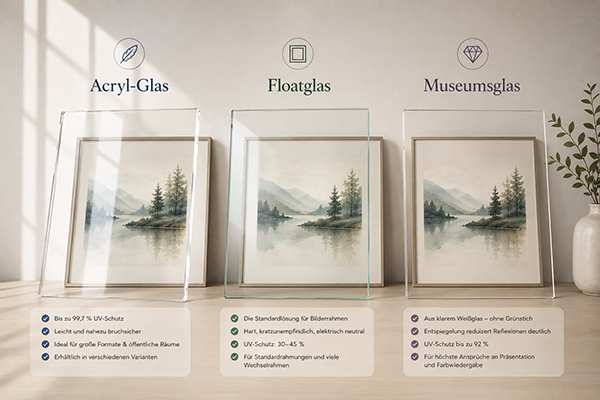
Float glass is the classic picture frame glass. It is hard, electrically neutral, and relatively scratch-resistant. However, it is often overlooked that float glass is not completely color-neutral.
Depending on the thickness, it has a slight greenish inherent tint, which can become visible particularly with light motifs or white Passepartouts. For conservationally demanding works, this can lead to a minimal optical distortion.
Float glass is installed as standard in many ready-made frames.
Standard Glass / Float Glass
- High-quality glass with ground edges
- robust and proven
- not anti-reflective
- UV protection from 30 to 45%
Due to its low UV protection, float glass is not suitable for framing valuable or sensitive artworks.
Standard Frosted Glass (Refloglas)
- Single-sided frosted surface to reduce reflections
- However, the matte texture also reduces the brilliance of the image.
- UV protection from 30 to 45%
Important: The Passepartout thickness should not exceed 2.0 mm. If the distance between the glass and the artwork is greater, the image may appear slightly blurred.
2. Acrylic glass – lightweight, shatterproof, and strong UV protection
Acrylic glass (PMMA) is significantly lighter than float glass and almost unbreakable. Especially for large formats, in public spaces, or during shipping, it offers safety advantages.
A significant advantage is the possible UV protection of up to 99.7%, which is particularly relevant for light-sensitive works.
The following acrylic glass variants are available in our range – custom-cut to the millimeter or in standard sizes:
Acrylic glass UV90
- 90% UV protection
- Very good light transmission
- Color-neutral
- Shatterproof
Not suitable for pastel or charcoal works due to possible static charge.
Anti-reflective Acrylic Glass
- Highest possible UV protection of 99.7%
- One-sided matte etched
- Anti-reflective
The same applies here:
The frosted surface takes away some of the image’s brilliance.
The Passepartout thickness should not exceed 2.0 mm, otherwise a slightly blurred impression may arise.
Not suitable for pastel or charcoal drawings due to static charge.
Optical HC
- 99.7% UV protection
- One side scratch-resistant hardened
- Particularly robust in handling
This variant is suitable for applications with higher mechanical stress.
The scratch-resistant side is marked with a pink protective film. After removing the protective film, we recommend placing a small mark on the edge of the glass surface to be able to identify the scratch-resistant surface again when changing the frame content.
Tru Vue Optium Museum Acrylic®
- Anti-reflective on both sides
- High optical clarity
- Scratch-resistant and anti-static on both sides
- UV protection 99%
This variant combines the safety advantages of acrylic glass with museum-quality presentation.
3. Museum glass – color-neutral and optically optimized
Unlike conventional float glass, museum glass is made from particularly clear white glass, eliminating the typical greenish tint.
In addition, modern museum glasses feature interference-optical anti-reflective coatings that significantly reduce reflections without diminishing image brilliance.
Museum glass UV70 (TrueColour)
- 4-way anti-reflective coating on both sides
- 70% UV protection
- High transparency
- Scratch-resistant protective layer
The remaining residual reflection is perceived as slightly greenish.
Museum glass UV92 (ClearColour)
- 6-way interference-optical anti-reflective coating on both sides
- Residual reflection below 1%
- UV protection 92%
- Very high transmission and clear contour sharpness
The minimal residual reflection is perceived as slightly bluish.
4. Electrostatic charge – relevant for conservation
Acrylic glass can become electrostatically charged.
This can be problematic for works with loose pigments (pastel, charcoal, chalk, graphite).
In such cases, glass – especially museum glass – is often the safer choice for conservation.
5. Which solution is appropriate when?
For large formats & public spaces:
Acrylic glass (safety aspect)
For maximum color purity:
Museum glass made from low-iron glass
For standard framing:
Float glass
For brightly lit rooms:
Anti-reflective variants (Refloglas or anti-reflective acrylic glass)
For pastel or charcoal works:
Float or museum glass
6. Conclusion
The choice of the right glass is not a question of “better or worse,” but depends on individual requirements.
Factors to consider include:
- Type of work
- Format
- Lighting conditions
- Safety requirements
- Conservation aspects
- Desired color reproduction
A deliberately chosen glass supports not only the presentation but also the long-term preservation of the work.