
Passepartout Quality – Which is Right for Your Artwork?
The selection of a suitable passepartout board should be made carefully, as it contributes significantly to the impact and protection of the framed motif. In addition to visual factors such as color, core color, and surface texture, the quality of the passepartout should play an important role and be tailored to the needs of the artwork being framed. It influences not only the visual presentation and ensures a harmonious appearance, but also fulfills important conservation requirements, thereby affecting the longevity and preservation of artworks, photographs, or documents.
While simple standard quality is primarily intended to serve decorative purposes and represents an affordable option, there are higher-quality grades that help to safely preserve artworks over many decades. Anyone wishing to frame their picture correctly should understand the differences between affordable standard and museum quality.
White-Core Standard Quality – A Solid Basis for Decor and Hobbies
Even standard materials today offer high quality and reliably preserve your work for many years. The affordable White-Core quality, with a board thickness of approximately 1.4 mm, is an acid-free passepartout quality with a white core that remains bright white and does not yellow over time, even after cutting. The material consists of purified wood cellulose from secondary fibers and achieves a pH value between 7.5 and 8.5 through buffering with calcium carbonate. With its various laminations, White-Core quality offers the greatest variety of colors in our range and is always a good choice for decorative framing and presentations, unlimited editions, and posters. However, White-Core quality is not intended for long-term archival storage.
Conservation Board – Conservation Quality for Photography and Archives
For higher-value artworks, limited editions, and documents worthy of archiving, we recommend our Conservation Board quality. The board is manufactured from high-quality, purified wood cellulose from virgin fibers, also known as alpha cellulose, and is characterized by being acid-free, lignin-free, and highly age-resistant.
The material meets the requirements of DIN EN ISO 9706 and, with a pH value of 8.0 to 8.5, offers reliable protection against age-related changes. Color pigments that guarantee high lightfastness and colorfastness also ensure a permanently high-quality appearance and excellent color quality.
Thanks to its material thickness of approx. 1.7 mm, the Conservation Board lends additional stability and a special sense of value to every framing. The material is ideally suited for high-quality graphics, photographs, art prints, and valuable documents that are to be protected long-term and maintained in the best possible condition.
MSK-Natur – Conservation Board Quality for Professional Presentations
The MSK-Natur material combines a high-quality look with first-class conservation properties and belongs to the same quality level as the Conservation Board material. Made from pure core material without surface lamination and available in thicknesses from 1.3 to 4.1 mm, it is particularly suitable for professional framing and demanding presentations. The exceptional thickness of up to 4.1 mm creates an impressive depth effect and emphasizes the value and exclusivity of the framed artwork.
MSK quality meets the highest requirements for long-term archiving and the protection of valuable works. The material consists of 100% alpha cellulose and is buffered with calcium carbonate. This buffering makes the material acid-free and, with a pH value of 8.0 to 8.5, it complies with the requirements of DIN EN ISO 9706. Furthermore, MSK quality is lignin-free and age-resistant, providing optimal conditions for the conservation framing of artworks, photographs, and documents.
Rag Mat Museum Quality – Highest Standards for Originals
The Rag-Mat Museum quality meets the highest standards for conservation framing and ensures the long-term protection of valuable exhibits. The material consists of 100% pure cotton cellulose and, due to buffering with calcium carbonate, is also acid-free and lignin-free with a pH value of 7.5 to 9.5. Thanks to through-dyeing with natural pigments, the material maintains excellent colorfastness and lightfastness. In this way, the board is protected as much as possible against bleeding and fading. Consequently, it meets the highest archival standards and is ideal for original artworks, historical documents, valuable photographs, and other sensitive works that are to be preserved for decades.
Depending on the version, the material is available buffered or unbuffered. There are 4 unbuffered boards specifically suitable for particularly sensitive objects such as cyanotypes (blueprints), dye-transfer prints, color photographs, or albumen prints. Unlike buffered materials, the unbuffered boards have a neutral pH value of 7.0.
The Rag-Mat material consists of pure core material without surface lamination, ensuring a particularly pure and high-quality material grade. With a thickness of approx. 1.5 mm, the passepartout combines timeless elegance with maximum protective effect – the first choice for museums, libraries, galleries, collectors, and anyone who refuses to compromise on archiving.
Comparison of Passepartout Qualities at a Glance
| Quality | Material | Features | Thickness | Suitable for |
|---|---|---|---|---|
| White-Core Standard | Cellulose with white core | Acid-free, affordable, not archival-safe | Approx. 1.4 mm | Hobbies, decoration, simple framing |
| Conservation Board | High-quality cellulose, alpha cellulose | Acid-free, age-resistant | Approx. 1.7 mm | Photographs, prints, long-term framing |
| Rag Mat Museum | 100% purified cotton cellulose | Acid-free, age-resistant, museum quality, solid core material | Approx. 1.5 mm | Originals, valuable artworks, archives |
| MSK-Natur | Natural board, alpha cellulose | Acid-free, age-resistant, solid core material | Approx. 1.3 – 4.1 mm | Professional presentations, exclusivity |
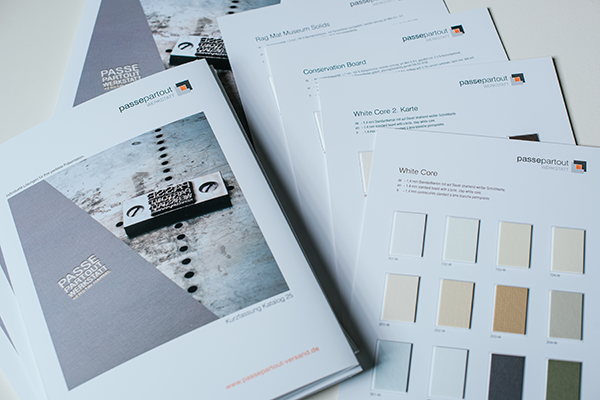
Color Samples of Passepartout Qualities
To get an overview of all the colors and surface textures of the various passepartout qualities, we offer you the opportunity to order free color sample cards.
Conclusion: Quality Determines Impact and Value Retention
While standard passepartouts are perfectly sufficient for decorative purposes, hobby projects, and exhibitions, conservation or museum quality should definitely be used for valuable works. Those who invest receive not only a beautiful frame but also the certainty that the image is optimally protected.
In our passepartout generator, you will find the complete range of passepartout qualities and colors.