
Passepartout – protection, impact, design & tips
A Passepartout is far more than a purely decorative element in a frame. It protects pictures, adds visual depth, guides the eye and ensures a professional presentation – whether for photographs, art prints or original artworks. Still, many are unsure: Do you really need a Passepartout ? Which material makes sense? What size is right? And when is a custom-made Passepartout worth it?
On the following pages, we answer all your questions and also show you how to create custom Passepartout s to the exact millimetre – including multiple openings, double Passepartout s, groove cuts, line rulings and embossing.
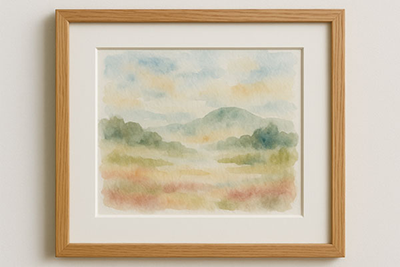
What is a Passepartout – and why is it so important?
A passepartout is a cardboard mount with a window opening that is inserted into a picture frame to create an additional border around artwork, photographs, and prints.
It serves several functions:
- It protects the picture from direct contact with the glass.
- It creates visual calm and showcases the subject effectively.
- Depending on the colour choice, it can highlight elements of the picture and create contrast.
- It increases the perceived value of a picture.
- It acts like a visual window onto the subject and adds a sense of depth.
As a rule, the use of Passepartouts in museums and professional framing studios is standard practice for framing, for both aesthetic and conservation reasons.
Visual impact: How a mat board elevates pictures
A mat board creates distance, calm and focus. It makes small subjects look larger and large subjects appear more balanced. Typical effects:
Depth effect
The border creates the impression of a “window”.
Professional framing
The picture looks high-quality framed – like in galleries.
Emphasised line guidance
Passepartouts guide the viewer’s gaze.
Colour psychology
White: neutral, modern, clear
Cream: warm, classic
Black: dramatic, ideal for black-and-white photography
Coloured: enhances moods or contrasts
Passepartout: decoration or real protection for your picture?
One of the most common questions is: Does my picture really need a Passepartout, or is it just decorative?
The answer is clear: A Passepartout also actively protects pictures from damage and ageing.
How does a Passepartout protect the picture?
No direct contact with the glass
This prevents trapped moisture, mould and “sticking”.
Buffer zone against temperature fluctuations
The board helps regulate temperature and humidity.
Acid-free materials protect colors and the image substrate
Inside the picture frame, thanks to its pH neutrality and the calcium carbonate it contains, the Passepartout binds acids present in the air that can attack colors and the image substrate over the long term.
Protection against mechanical pressure
The picture sits freely and is not compressed.
Passepartout qualities: standard, acid-free, or museum board?
All our Passepartouts are fundamentally made acid-free and – if laminated with white core material – have a permanently white cut edge. This means they already meet important requirements for safe, material-friendly framing.
Depending on the desired appearance and functional requirements of the Passepartout, you can choose from four different quality grades. If, for example, you are looking for vibrant colors, our White Core quality is an excellent choice. For particularly valuable or delicate artwork, we also offer Museum Quality, made from cotton fibres and meeting the highest standards for aging resistance and archival preservation.
Thickness:
A thicker mat board often makes the Passepartout appear more impressive and gives it a more premium look.
The board thickness can significantly enhance the depth effect.
The right dimensions for your Passepartout
The most important rule is: The Passepartout should not overwhelm the picture, but highlight it.
Possible guideline values (depending on picture size):
- Small formats: 3–5 cm border
- Medium-sized pictures: 5–8 cm border
- Large formats: 8–12 cm border
Ultimately, however, personal taste is the deciding factor here. Often, certain circumstances are already in place that you need to take into account. This could be limited wall space, an existing frame for your picture, or other existing frames in the same room.
Opening:
The inner opening should overlap the picture by 2–5 mm all around so that the picture can be adjusted without any problems and the picture edge does not show out of the opening. The inner opening must therefore be chosen smaller than the picture size.
Naturally, this rule does not apply to cut-out works that are intentionally much smaller than the opening.
Why a custom-made Passepartout is often the right choice
The selection of standard Passepartout is limited to common outer formats, typical picture sizes and a centred opening position. In addition, the board selection is limited to a small range of the different qualities, generally in muted colours such as white, cream, grey and black. A custom-made Passepartout , on the other hand, offers a wide range of options:
- wide colour selection of around 100 colours
- different board thicknesses (1.3 mm to 4.1 mm) and qualities
- different surface textures
- Individual opening positions – centred, optical centre, golden ratio, top/right/left equal, or freely positioned
- Different opening shapes
- Multiple openings for picture series, also in different sizes
- Groove cuts and line rulings as elegant embellishments
- Double Passepartout s for a special depth effect
- Production of hinged Passepartout s and slip-in Passepartout s
Our configurator for custom Passepartouts offers:
- true-to-scale visualisation in the preview
- direct data transfer to our professional cutting plotters
- precise production without tolerance errors
- Embellishments (groove cuts, line rulings and double mat boards) can be added quickly and easily
- You always see the current price for the Passepartout you have created
Possible embellishments for your Passepartouts
Groove cut
A groove cut is a scored indentation with a small, continuous distance around the picture opening. With laminated boards, the core colour becomes visible and creates a contrasting colour accent.
Line ruling
This is a fine gold or silver line with a small, continuous distance around the picture opening.
Double Passepartouts
These are two or more Passepartoutss stacked on top of each other, where the openings become slightly larger towards the top, creating a “stepped” effect. The depth effect is enhanced and there is the option to add color accents.
Embossing
Add a distinctive, personal touch to your Passepartouts with custom embossing featuring your logo or company name.
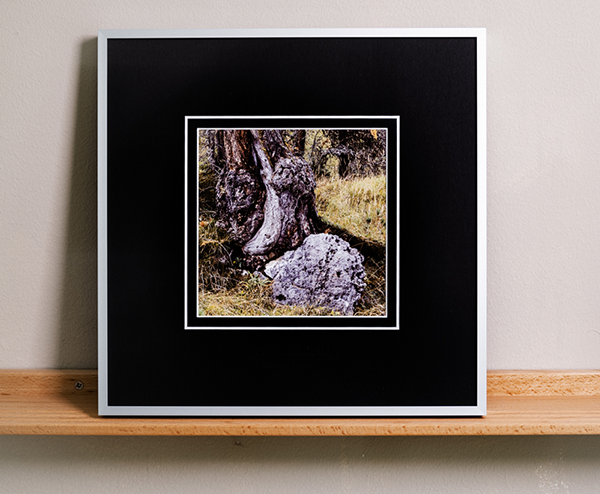
Passepartout & picture frame: the perfect combination
A Passepartout should never be considered in isolation – combined with a suitable frame, it creates a complete work of art.
Important factors:
- Frame colour
- Frame material
- Rebate depth (especially for thicker Passepartouts)
- Frame moulding width
- Type of glass
A Passepartout can help balance unfavourable aspect ratios and adapt the picture to a desired frame size.
Possible sources of error when buying a Passepartout
- the opening size of the Passepartout is equated with the picture size
- the rebate depth of the frame is too shallow for a thick Passepartout
- the outer format of the Passepartout does not fit the intended frame
- Slip-in Passepartouts for long-term framing
As a general rule: If you have any questions, or if anything is unclear or you run into problems when choosing your products, please feel free to contact us. We will be happy to help.
Conclusion: Why every picture benefits from a Passepartout
A Passepartout adds real value to any framing:
- protects
- stabilises
- enhances
- focuses
- extends the lifespan of the picture
- looks professional and high-quality
And thanks to modern technology, you can now design Passepartouts with absolute precision online:
✔ Multiple openings
✔ Line rulings & groove cuts
✔ True-to-scale preview
✔ Exact machine production
Configure your custom-made Passepartout now — to the exact millimetre and made to a high standard.